From 1 April 2027, Disability Confident will stop asking what you've committed to and start asking what you can prove.
Key points
- The Department for Work and Pensions (DWP) published reforms to the Disability Confident employer scheme on 26 November 2026. The changes start on 1 April 2027.
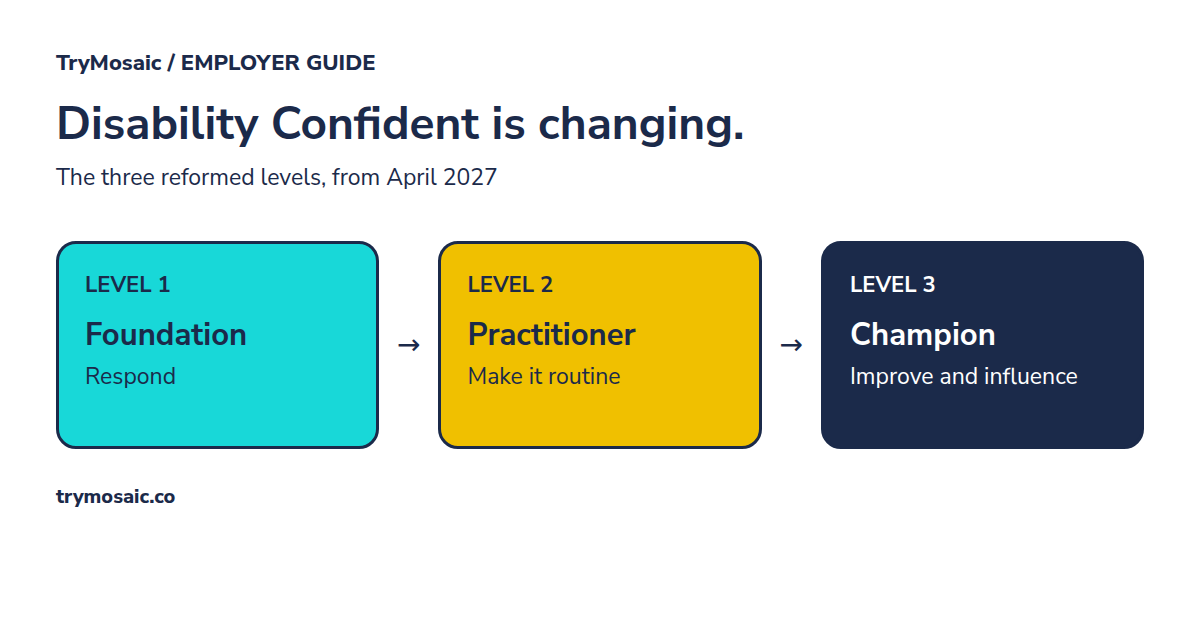
- The three levels are renamed: Level 1 Committed becomes Foundation, Level 2 Employer becomes Practitioner and Level 3 Leader becomes Champion.
- Level 1 is now time-limited to a maximum of two years. Employers then progress to Level 2 or leave the scheme.
- Level 2 has 13 published criteria and an annual Progress Statement. Workplace adjustments are named in five of the 13 criteria.
- Level 3 gets enhanced independent verification, fully in place from 1 April 2028.
- Existing members don't need to rejoin. They move onto the reformed scheme at their first renewal after 1 April 2027, with transitions running to 2030.
What is changing in Disability Confident?
On 26 November 2026, DWP published the biggest reform of Disability Confident since the scheme launched in 2016. It moves the scheme from commitment to evidence.
| Old level | New name | DWP's focus |
|---|---|---|
| Level 1: Disability Confident Committed | Foundation | Respond |
| Level 2: Disability Confident Employer | Practitioner | Make it routine |
| Level 3: Disability Confident Leader | Champion | Improve and influence |
Every level covers the same three themes: recruitment and onboarding, in-work support, and absence and return to work.
This is a good change. It rewards employers who are doing the work. But it raises the bar on evidence, and what you need to do next depends on where you are today.
How many employers are affected?
Around 19,300 employers are registered with Disability Confident. Nearly three in four are at Level 1.
| Where you are today | Employers | What the reform means for you |
|---|---|---|
| Level 1: Committed | 14,063 | Up to two years to reach Level 2 once you move onto the new scheme |
| Level 2: Employer | 4,411 | Meet the new criteria at renewal, then evidence them every year |
| Level 3: Leader | 831 | Independent verification from April 2028 |
Source: TryMosaic analysis of DWP's September 2026 Disability Confident employer list.
What happens if you're at Disability Confident Level 1?
What it means
You move onto the new scheme at your first renewal after 1 April 2027. From then, you have up to two years to reach Level 2. If you don't, you leave the scheme.
What Level 2 asks for
Workplace adjustments are named in five of the 13 Level 2 criteria. In practice, that means:
- Every adjustment is agreed, recorded and reviewed
- Support carries on when a role or manager changes
- Requests get timely decisions, with interim support where needed
- Managers can have the conversation and act without delay
- Adjustments come up in routine wellbeing and performance conversations
Your gap
Most Level 1 employers already have the policy and the goodwill. What's missing is the process and the record. Adjustments get agreed informally, tracked in spreadsheets and inboxes, and lost when a manager moves on. That's the key difference between Level 1 and Level 2.
What to do
- Find your renewal date. It's when you move onto the new scheme and your two years begin.
- Walk one adjustment request end to end. Note where decisions stall and where the record disappears.
- Put every adjustment in one system, with decisions, reviews and owners recorded.
- Run it before renewal, so you have months of evidence, not a promise.
What do Disability Confident Level 2 employers need to do?
What it means
You're not done. You keep your Level 2 status, but you move onto the new criteria at your first renewal after 1 April 2027. DWP will set out the evidence it expects before then. From that point, you publish a Progress Statement every year showing what you did, what improved and what comes next. The same 13 criteria, continuously. Not a snapshot at renewal, but a year of decisions, reviews and outcomes, every year. Many employers reached Level 2 on the strength of their policies and commitments. The new criteria ask for a routine you can prove. If your evidence sits across HR records, spreadsheets, surveys and inboxes, every Progress Statement becomes a scramble.
What to do
- Find your renewal date. It's when the new criteria apply to you.
- Score yourself against the 13 criteria: met and provable, met but not provable, or not met.
- Make evidence part of everyday work, so your Progress Statement draws on real data, not a last-minute search.
What are the Disability Confident Level 2 criteria?
DWP's 13 Practitioner criteria, summarised. The five that name workplace adjustments are in bold.
| No. | Theme | Level 2 Practitioner criterion |
|---|---|---|
| 1 | Recruitment and onboarding | Recruitment and onboarding practices are applied consistently and reviewed to remove barriers. |
| 2 | Recruitment and onboarding | Workplace adjustments are considered and offered consistently during recruitment, and roles are reviewed for flexibility in hours, location or tasks before advertising. |
| 3 | Recruitment and onboarding | Everyone involved in recruitment understands inclusive practice in their role. |
| 4 | Recruitment and onboarding | Accessibility is built into recruitment platforms, assessments and communications. |
| 5 | In-work support | Workplace adjustments and support plans are agreed, recorded and reviewed, so the people who need to know can see what is in place. |
| 6 | In-work support | Support and agreed changes to role design or workload continue when roles or managers change. |
| 7 | In-work support | Adjustment requests receive timely responses, clear communication and interim support where needed. |
| 8 | In-work support | Support and adjustments are part of routine wellbeing and performance conversations. |
| 9 | In-work support | Managers are supported to hold confident, timely conversations about disability, health, flexibility and adjustments. |
| 10 | In-work support | Development and progression opportunities are inclusive and tailored to individuals. |
| 11 | Absence and return to work | Employers use learning and feedback to improve how disabled employees stay, progress and succeed. |
| 12 | Absence and return to work | Flexible working, adjusted duties or job carving are considered for phased returns and retention. |
| 13 | Absence and return to work | Feedback is gathered at key moments, such as emerging health concerns, sickness absence and return to work, and used to improve. |
Source: DWP, Understanding the new Disability Confident levels and criteria.
How TryMosaic helps you reach Level 2, and stay there
TryMosaic is the system of record for workplace adjustments. Use it to manage adjustments, and it builds your Level 2 evidence as you go.
| Level 2 criterion | What TryMosaic does | The evidence you get |
|---|---|---|
| Adjustments agreed, recorded and reviewed | Documented agreements, implementation tracking and automated review reminders | A complete, auditable record of every adjustment and its reviews |
| Support continues when roles or managers change | Employee adjustment passports | Agreed support that follows the employee, not the manager |
| Timely responses to requests | One request and decision workflow | Request-to-decision times you can report on |
| Managers supported to act confidently | Manager guidance and e-learning built into the workflow | Training records alongside the decisions managers make |
| Support part of routine conversations | Employee coaching and check-ins | A record of regular check-ins on whether support is working |
| Learning used to improve support | Organisational analytics and reporting | Trends and data ready for your Progress Statement |
Employers using TryMosaic see average request-to-decision times of five to eight days. One customer cut theirs from around three months to five days.
At Level 1, TryMosaic gives you the process and the record to reach Level 2 within your two years.
At Level 2, it keeps your evidence building all year, so every Progress Statement and renewal is straightforward.
Frequently asked questions
When do the Disability Confident changes start?
The reformed Disability Confident scheme starts on 1 April 2027. DWP is publishing further guidance between December 2026 and March 2027.
What are the new Disability Confident levels?
Level 1 is Foundation, Level 2 is Practitioner and Level 3 is Champion. They replace Disability Confident Committed, Employer and Leader.
How long can an employer stay at Disability Confident Level 1?
A maximum of two years. Employers who don't progress to Level 2 in that time leave the scheme.
Do existing Disability Confident members need to rejoin?
No. Existing members move onto the reformed scheme at their first renewal after 1 April 2027. Transitions run from 2027 to 2030.
What is the Disability Confident Progress Statement?
An annual statement that Level 2 employers must complete. It covers the previous year's activities, the progress made and priorities for the year ahead.
What changes for Disability Confident Leaders at Level 3?
Level 3 renewals between 1 April 2027 and 31 March 2028 fall in a supported verification year. Full enhanced independent verification applies from 1 April 2028.
Is Disability Confident mandatory?
No. Disability Confident is a voluntary scheme, and employers' legal duties under the Equality Act 2010 are unchanged.
Do you need software to reach Disability Confident Level 2?
No software is required. But Level 2 asks you to show that adjustments are recorded, reviewed and handled consistently. A system of record such as TryMosaic makes that evidence part of everyday work.
Ready to show it?
Whether you're working towards Level 2 or want to stay there, TryMosaic can help. We're disabled and neurodivergent-led, and we built TryMosaic to make reasonable adjustments unreasonably easy.
Talk to TryMosaic about Disability Confident Level 2
Further reading
- DWP: Disability Confident reform
- DWP: Disability Confident reform launch pack
- DWP: Understanding the new Disability Confident levels and criteria (PDF)
- DWP: Existing Disability Confident member transition guide (PDF)
- DWP: Disability Confident employers that have signed up
TryMosaic is an independent software provider and does not award or guarantee Disability Confident status. We'll update this article as DWP releases further guidance.
By Ryan Hoare, Founder of TryMosaic. Published 27 November 2026. Last updated 27 November 2026.